|
.jpg)
Click on book cover to order!
Book Excerpts Below |
Hiking Mississippi

ISBN: 0762711175
This book details 50 hikes that take place in Mississippi,
from the Coldwater Nature Trail near the Tennessee state line to the boardwalks
at Davis Bayou on the Gulf Coast and throughout the state between. Specific
emphasis was placed on the most scenic destinations and unique places that make
Mississippi so special, places like the rocky Bear Creek, the waterfalls of
Clark Creek Natural Area and the crest of Little Mountain.
Mississippi
offers distinct regions in which to trek, the lake country of North Mississippi,
the Delta and piney midlands of the Heart of Mississippi and the Coastal Plain
of South Mississippi. Hikes covering all three areas, of assorted lengths and
difficulties, are included, and add to the variety of experiences.
|
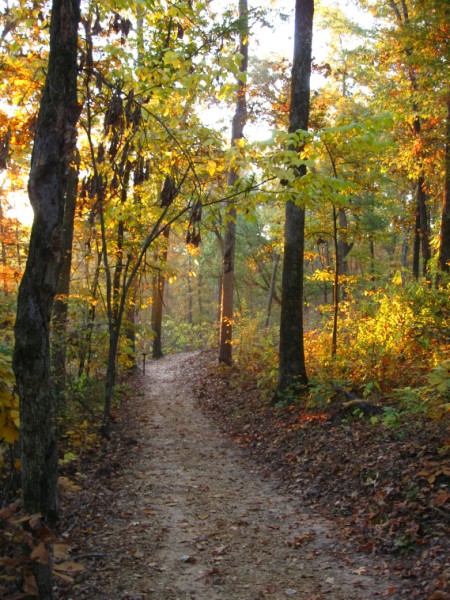
Fall Hiking in Mississippi
Book Overview Many hikes take
place in Mississippi’s six national forests covering 1.2 million
acres spread about the state. These forests not only have hiking
trails, but also campgrounds, waterways to float and fish, special
scenic areas, botanical areas, hunting and more. Mississippi state
parks and forests also dot the land and are destinations for those
who want to hike and explore. Wall Doxey State Park harbors
innumerable springs. Lake Lowndes State Park offers recreation of
all stripes, including, of course, hiking. Leroy Percy State Park
has brooding swamp woods. These are but three examples of a fine
state park system of which Mississippians should be proud. And don’t
forget the linear national park that extends 310 miles through the
Magnolia State – the Natchez Trace Parkway. The Parkway functions as
a corridor of protected land on which numerous hiking trails are
found, including preserved sections of the historic Trace. No matter
what entity manages the land, there is plenty to see in this state,
from winding blackwater rivers to waterfalls framed in rich forests,
to rock outcrops where overhangs provide trailside shelter to dark
swamps where nature’s beasts find retreat. You must reach these
places by foot. The rewards increase with every footfall beneath
stately pines on a sunny knoll or along a scenic lake. A respite
into the “real” Mississippi will revitalize both mind and spirit. To
wander through remote forests, to contemplate pioneer lives at an
old homesite or to peer into a cypress swamp will put our lives into
perspective.
That is where this book will come
into play. It will help you make every step count, whether you are
leading the family on a brief day hike or undertaking a challenging
backpack into the back of beyond. With your precious time and the
knowledge imparted to you, your outdoor experience will be realized
to its fullest.
With the joy of completing a book and the
sadness of an adventure ended, I finished my research. But I will
continue putting my lessons to work, enjoying more of Mississippi in
future outdoor adventures. May this book help you get out and make
some memories of your own, trekking the treasures of the Magnolia
State.
Weather
Mississippi’s climate experiences offers good
hiking conditions most of the year, and four distinct seasons, with
high summer being the only time not conducive for hiking. During the
long summer highs regularly reach the 90s and a thunderstorm can
come most any afternoon. Warm nights stay up in the 70s. Fall brings
cooler nights and warm days. October is the driest month. Winter is
variable. By the Gulf highs push 60 degrees. Expect lows in the 40s,
though subfreezing temperatures are the norm during cold snaps. Up
north, winter highs are in the low 50s. No matter where you are in
Mississippi there are usually several mild days during each winter
month. Precipitation comes in strong continental fronts, with
persistent rains followed by sunny, cold days. Snow is uncommon,
though not unheard of. The longer days of spring begin the warm-up
process, becoming even hot, but temperatures can vary wildly. Spring
will move north from the Gulf but is in full control of the entire
state by mid-April. Using Jackson as a baseline, the rainiest months
are from November through April. It is this same span that highs
average below 80, which are more favorable for hiking. However, you
can still hike during the warmer months. Try to do your trekking in
the mornings, that way you will also avoid most summer
thunderstorms.
Mississippi’s topography ranges from the
Appalachian Foothills in the northeast to the Piney Hills to the
enormous and wild Mississippi River bottoms to the Gulf Coast. Thus,
the state’s flora and fauna reflects this variety. Mississippi is a
bit over 50% is forested. The creeks and major river bottoms are
covered in cypress, tupelo and wetland oaks, as well as beech and
the straight trunked tulip tree. Shortleaf pine is king in the
upland areas, along with its partners, the drier oaks – such as post
oak and red oak, and mockernut hickory. Longleaf and slash pines are
more common in central and south Mississippi, with loblolly pines
being in the moister areas of the south. Planted pine plantations
extend throughout the state. Sweetgums seem to be everywhere.
Wildlife is abundant throughout the state.
Raccoons, rabbits and squirrels range wide. Deer are found in high
numbers and are the mammal you are most likely to see. Kudzu -- of
which Mississippi has plenty -- is an important browse food for
deer, especially where they are in high numbers. Fawns use the dense
vine cover of kudzu to stay hidden. Deer population estimates vary,
with some ranging as high as a staggering 1.75 million of these
four-legged creatures.
The black bear is making a comeback, but their
numbers are limited to a few hundred. The state features two
species, the American black bear and the endangered Louisiana black
bear. They reach their greatest numbers in the Delta near Rolling
Fork and all along the Mississippi River corridor from Louisiana to
a couple of counties south of Memphis. Some are also found in the
national forests in south Mississippi. A few are sighted every year
in the northeast as well. Black bears are federally protected in
Mississippi as a threatened subspecies, the subspecies being the
Louisiana black bear.
The American alligator also ranges throughout
south and central Mississippi, but sometimes can be found as far
north as Lafayette County. Population estimates range around 35,000
spread out over 400,000 acres of alligator habitat. One quarter of
all the state’s alligators live in Jackson County, home of
Pascagoula. Another coastal county with a high population is
Hancock.
The coastal component of Mississippi is
comprised of marshes, beaches, dunes and barrier islands. The
saltwater influenced environments are worlds unto themselves, with a
variety of saltwater fish and mammals, including sharks and sea
turtles. Pelicans, herons, egrets, skimmers and other shorebirds
occupy the Gulf Coast.
|