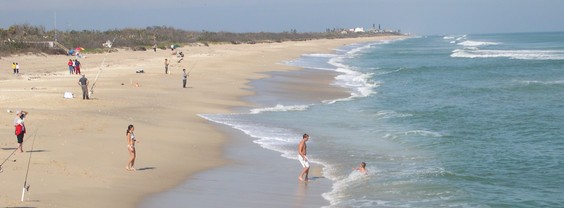
Sebastian Inlet State Park
Book Description
Filled with pictures
and practical tips, this user-friendly paperback guidebook offers
down-to-earth, detailed advice about the 42 best Atlantic Ocean- and
Gulf of Mexico camping areas in the Southeast for both tent and RV campers.
From the shores of Maryland, down to the Outer Banks, and south to
the Florida Keys,, up the Gulf, and over to the long coast of Texas Molloy selected these state and
national parks for their scenic beauty, recreation potential, and
proximity to the Atlantic Ocean or the Gulf of Mexico. His list
includes everything from ultra-rustic to highly developed sites, all
compactly organized by geographic region.
Accounts of each site feature:
· an overview of both the site and the surrounding area;
· a description of the shoreline and its features;
· details of the campground, including pictures, amenities, and
seasonal features;
· notes on the human and natural history of the surrounding area;
· guides to local activities, from snorkeling to bike trails;
· descriptions of local attractions, shopping, and dining
opportunities;
· essentials of how to make reservations and get there, including
phone numbers, driving directions, size of campsite, facilities,
regulations, and more.
For visitors and residents, retirees, college students, and families
with children, this book will simplify the coastal camping
experience. Johnny Molloy has done the research and provided the
best selections from thousands of miles of coastline in the
Southeast.

View of Padre Island
Book Excerpt
Padre Island National Seashore
Corpus Christi, Texas
Padre
Island National Seashore is a land, well, island, of superlatives.
For starters, this Texas coastal gem lays claim to being the world’s
longest barrier island. A staggering 113 miles from end to end, it
used to be even longer before the Mansfield Channel, which now marks
the islands southern terminus, was cut as a shipping lane in 1964.
The national seashore portion of Padre Island extends for 80 miles
and ends at Mansfield Channel. And the entire Gulf frontage of the
protected national seashore is beach! Here, the Gulf crashes into a
wide sandy swath backed by high dunes that reach well back from the
coastline. Most of the island remains in a natural state and is
accessible only by four-wheel drive vehicles. However, the park has
some infrastructure, including a campground, visitor center, day use
beaches that make it accessible and enjoyable by all, including
those with ordinary passenger cars or a big RV.
The Beach/Coast
At
most beach destinations, pockets of natural beach are surrounded by
civilization. Here on Padre Island, a few pocket of development are
surrounded by nothing but nature. You will notice that driving into
the national park. The coastal prairie has rolling,
vegetation-covered dunes broken by ponds. The crash of the ocean is
never far away. Padre Island has so many dunes, you may be tempted
to call it Texas Hill Country By the Gulf. From north to south, the
first beach access on Padre Island is North Beach. Then you reach
Malequite Beach, which is the primary park development and
recreation area. Malequite Beach Campground is on the Gulf side of
the dunes. Just to the south is the park visitor center, with its
ample facilities.
The
primary beach access is at the park visitor center. Here is a
bathhouse, a shaded picnic area, small grocery, cold showers,
informative displays and an observation deck. A walkway leads to
the Gulf, where three miles of beachfront are closed to vehicles.
Large dunes back the wide beach here. Shaded beachfront picnic
cabanas are claimed quickly. No cars are allowed on this stretch of
sand. South Beach is south of Malequite Beach. Here is an auto
beach access, and where all manner of vehicles drive and camp on the
beach for the first four miles. Four-wheel drive vehicles only are
recommended south of the four mile mark. Intrepid and well prepared
explorers can travel the entire 60 miles of southward beach to
Mansfield Channel.
The Campground
Padre Island has
many types of camping, from primitive beach camping with no
facilities to the organized and designated Malequite Beach
Campground. A road breaks through the dunes to reach
Malequite
Beach. The 42-unit campground is stretched lengthwise along the
water with commanding beach and Gulf views. The campsites are
situated a bit close together. Dunes back the camping area. The
sites closest to the beach are the best, as the sites away from the
beach are small and mostly pavement. At each end of the camping
area are four tent campsites that have shade cabanas at them. A
beach access leads down to the water. Bigger RVs may have trouble
pulling into the pull-ins if the campground is crowded. A
campground host keeps things safe and organized. Malequite Beach
Campground rarely fills, save for spring break. The reason for this
is because there are so many other camping opportunities at Padre
Island. For starters, Bird Island Basin offers campers a chance to
overnight on Laguna Madre, the bay side of Padre Island. Camping is
a bit of a free-for-all here, with no designated sites, but the area
does have some vault toilets. Yarbrough Pass Campground is
accessible only by four wheel drive vehicle and is also on Laguna
Madre. However, Padre Island is probably best known for its
primitive beach camping. A beach access road is located just south
of the Visitor Center. Here, visitors can drive right onto the
sand. The first four miles of beach is accessible by all vehicles
including RVs! Yes, you will see RVs driving on the beach.
Four-wheel drive vehicles are needed beyond the four mile mark and
you can camp anywhere along the beach for 60 miles all the way to
Mansfield Channel! Solitude seekers will have no problem here.
Free permits are required for primitive beach camping.
Human and Natural History
The
Karankawa Indians, whose height, propensity to tattoo their faces
and somewhat erroneous reputation as cannibals painted them as a
fierce tribe to be defeated by European settlers, first inhabited
Padre Island. They were quickly eliminated from the Texas coast via
disease, warfare and inability to adapt to Western ways. Later,
Spaniards visited the island but left it to nature until Father Jose
Nicolas Balli founded a mission and ranch on the island in the early
1800s. Its early name of White Island faded with time and the
mission led to the new name of Padre Island. Padre Balli hired out
help for the ranch and never actually lived here, though his nephew
continued operations until his death in the 1850s. The relentless
winds, storms and hurricanes eventually buried the ranch at Padre
Island. However, the name Padre Island stuck.
What To Do
Padre Island
is a natural Gulf experience at its best. The wide, dune backed
beaches are the main draw. Folks can enjoy beachfront with or
without their vehicles. Swimming, beachcombing, surf fishing are
the primary activities on the Gulf.
Secondary
park activities are birding, wind surfing and kayaking. The entire
park is open to birding and the many habitats offer changing birding
experiences. Up to 350 species of birds visit or call Padre Island
home during the year. Fall and winter are the best times to bird
here.
The
calmer waters of Bird Basin are popular with those who want to enjoy
the recreation opportunities of Laguna Madre. The park’s only boat
ramp is here. The waters of the bay are usually enjoyed by anglers,
who carefully boat the shallows in search of redfish, sea trout,
pompano, jack crevalle and catfish. Surf fishing on the Gulf side
yields many of the same species. Big Shell Beach is purportedly the
best surf fishing locale in the park. Windsurfing is popular in
Laguna Madre, as is kayaking. A seasonal kayak rental facility is
located on Laguna Madre at Bird Basin.
Thos
who want to learn more about the national seashore can enjoy some of
the daily interpretive programs, walks and films about such topics
as Gulf turtles, shoreline life, dune formation and also island
birds.
What’s Nearby:
The
town of Corpus Christi is within easy striking distance of Padre
Island. The town offers a full complement of restaurants and other
major city facilities. The Corpus Christi Museum of Science and
History is a worthy endeavor. The USS Lexington, also known as the
“Blue Ghost,” is a retired navy battleship that survived the attack
on Pearl Harbor of December 7, 1941. You can tour the ship, and see
artifacts from not only this ship but also the USS Arizona, which
was sunk during the day “that shall live in infamy” as FDR put it.
Visit the Texas State Aquarium that features freshwater and
saltwater life that as a beach camper you will surely enjoy.
Information
Padre
Island National Seashore
Box 181300
Corpus Christi, TX
78480
(361)
949-8068, www.nps.gov/pais
Sites: 34
pull-in sites, 8 tent sites, unlimited completely primitive beach
and bay camping
Amenities:
Picnic table, some sites have shade cabanas
Registration: Self-registration on site
Facilities:
Cold showers, flush toilets, water spigots
Fees: $8
per night at Malequite Beach, $5 per night at Bird Basin, primitive
camping free
Directions: From
Corpus Christi, take TX 358 east until it becomes Park Road 22.
Keep forward on Park Road 22 and follow it across Laguna Madre onto Padre Island
and continue south to enter the park.
|