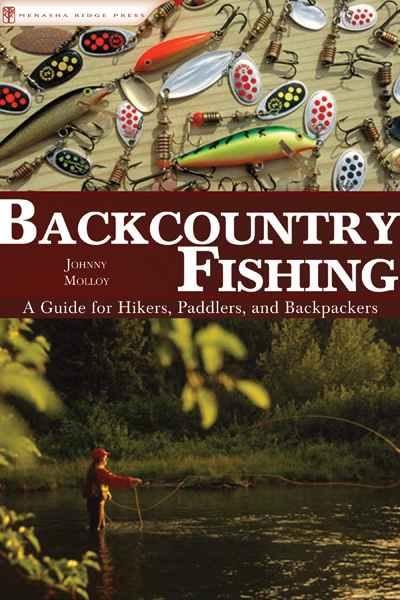
Book Overview
Backcountry
fishing separates you from the crowds, from those anglers literally
unwilling to take the extra step, to leave the pavement or the
powerboat to go head-to-head with swimming creatures lurking under
the fluid waters that reflect the lands around them. And when
fishing fever strikes, there is only one cure. If you are in such a
state, why not go in a superlative setting? Why not go backcountry
fishing?
For many of
us, the lure of fishing is not always the fish, but the places where
the fish are. Tossing a rod is just the excuse for heading into the
back of beyond, to enjoy nature on nature’s terms, to get past the
parking lot to enter the backcountry… to follow a foot trail tracing
an Appalachian trout stream beneath a shady forest canopy,
Fishing Wyoming's Cloud Peak Wilderness
or cast for
bass along a sun splashed Ozark river, where inviting gravel bars
offer campsites below magnificent bluffs … to trace a Rocky Mountain
watercourse as it winds through a meadow flanked by majestic snow
capped peaks … to see what lies under the froth of a Sierra
tributary flowing along granite banks … to paddle through a winding
mangrove maze in the Everglades, casting for salty species
inhabiting that unique slice of America.
This guide covers backcountry fishing, whether day tripping in a
canoe, day hiking along a remote river, going for a multi-day
excursion in Quetico Provincial Park of Ontario or a weeklong
backpack fish fest in the Gila Wilderness of New Mexico. Whether fly
fishing, spin fishing, or saltwater fishing, with this book in hand
you will be prepared not only for how to catch fish in the outback
but how to be best prepared for backcountry fishing excursions.
BOOK EXCERPT
Whether going by
foot or by self-propelled craft, such as a canoe or kayak,
backcountry travel leads anglers from an auto accessible trailhead
or put-in to a fishing destination they must reach on their own,
without a car or motorboat. This is backcountry fishing. The
simplest way is to get there by foot. No means other than you are
required. Walking or hiking to the destination requires merely a
trail and a body of water, whether it be a lake or stream. You may
choose to go on a day trip or backpack for several days. Outback
travel by boat is a little more complicated. A canoe or kayak is
needed. In this situation backcountry anglers start at a put-in and
if by river, travel downstream, maybe camping, maybe not, then
ending at a take-out. Other times, anglers will start and end in the
same place, especially when traveling lakes, or a series of lakes
connected by portages. Many kayaking destinations will be in
saltwater.
Weight and Space
Weight and space separates
backcountry fishing from the ordinary fishing excursion. If taking a
bass boat on the local reservoir for the day, you will likely take
the kitchen sink along. Or if bait fishing from a river bank
accessible by car, you can take whatever you want, including the jar
of picked pig’s feet upon which to dine. However, if backcountry
bass fishing the Virginia’s New River, you can only bring what’ll
fit in a canoe, or if backpack fly fishing Wyoming’s Bridger-Teton
Wilderness you want to most efficiently use weight and space.
Backcountry Decision Making
The first determination is what
kind of fish I will seek. This will determine the equipment to use.
Say I am going for cutthroat trout on Slough Creek in Yellowstone National Park.
I will be hiking a mostly open path to reach a stream that meanders
through open meadows. This tells me I can use a longer rod and won’t
have to worry as much about storing and transporting it before
reaching the creek. Once on the creek, I’ll be able to walk along
the meadows, and fish from gravel bars that lie on the inside of the
stream bends. It is summer. So, I’ll wear hiking shoes that’ll
double as fishing shoes, and bring a light jacket in case a
thunderstorm blows up. In my daypack I’ll carry a lunch and my
camera for the many scenic shots available, with the lesser
probability of losing it in brush or dropping it in the water.
I am going to catch and release
fish, so won’t be carrying a creel or other means of keeping fish.
Slough Creek has many pools and slack areas between faster sections.
It is primarily populated with cutthroat trout, which are a lesser
fighting cold-water fish. This is a good fly-fishing venue. It has a
good insect population, and I will use a dry fly with a grasshopper
pattern, to watch the spectacle of a cutthroat rising to strike.
I’ll have plenty of casting room, with no overhead obstructions, and
will be able to run the fly for relatively long distances down the
stream.
Now say I am going trout fishing
on a small and overgrown stream of the Cohutta Wilderness in the
North Georgia
Mountains. I will be hiking a lesser maintained, thickly vegetated
trail to access the stream. This tells me to use a shorter,
two-piece rod (under five feet) and to carry it in my hand while
walking or keep it well stowed while trekking between the trailhead
and the stream access. It is spring. The weather is variable, so I
will keep a fleece jacket and a rain jacket in my daypack. Since the
stream is overgrown I will likely have to wade nearly the whole
time, so will bring lightweight felt soled fishing shoes for on the
water, and wear some sturdy hiking boots with ankle support to reach
the stream access. I will cast ultra light, ¼ to 1/8 ounce spinners.
Since the keepers of legal size on this tiny stream are rare I will
not carry any fish holding gear.
Such are
the type of decisions to make while backcountry fishing, and where
you will be able to find answers in this book. We will go through
the whats – what rod, what tackle, what lures, what techniques, and
the hows – proven techniques for locating and catching fish in the
outback, and the where’s – a complete suggestion list of
destinations are in Appendix X of this book.
Backcountry
Fishing: What It's Like
It's
acrobatically stepping up a rocky stream under dark green tunnels
with shafts of sunlight illuminating trout pools
It's
throwing your lure from the beach and a watching a snook hit it with
a vengeance then burst upward toward the sky, landing on its side
with the crash.
It is
having your line snap at precisely the wrong moment on Maine’s
Allagash River
It's
dropping a floating Rapala over a spawning bed and watching two
smallmouth bass get hooked at once
It's
walking up the canyons of the Middle Fork Gila River with stone
spires rising on their edges as you fish translucent waters for Gila
trout and smallmouth bass
It's
reaching the gravel bar campsite with bragging rights for the
biggest fish of the day
It's
quickly reeling in your fish as the boat turns sideways before
hitting a partially submerged tree
It's
drifting a fly down Panther Creek in June and catching a fish in
front of the other anglers who have been shut out
It's
planning on eating fish that night and returning to camp
empty-handed only to find everyone else got shut out too
|